

ARTICLE SERIES · Part 3 · Experience and new directions
What do I do now with what I have learned over twenty years?
How can development experience create new opportunities for clients? Business processes, early prototypes and personal responsibility for the work.
In this article
When someone has worked with the same developer for years, the impression they formed during their first project together can easily stick. If that person built a website back then, a website is what people continue to approach them about. Meanwhile, they may already be developing booking systems, business software and complex integrations. There has simply been less conversation about that.
That is why moving forward with AI is partly about making it clearer where I can help today. The tools are changing, but the starting point is familiar: I want to understand what the client is working on, where they get stuck, and how that could become a system people genuinely enjoy using.
Starting the conversation with a different question
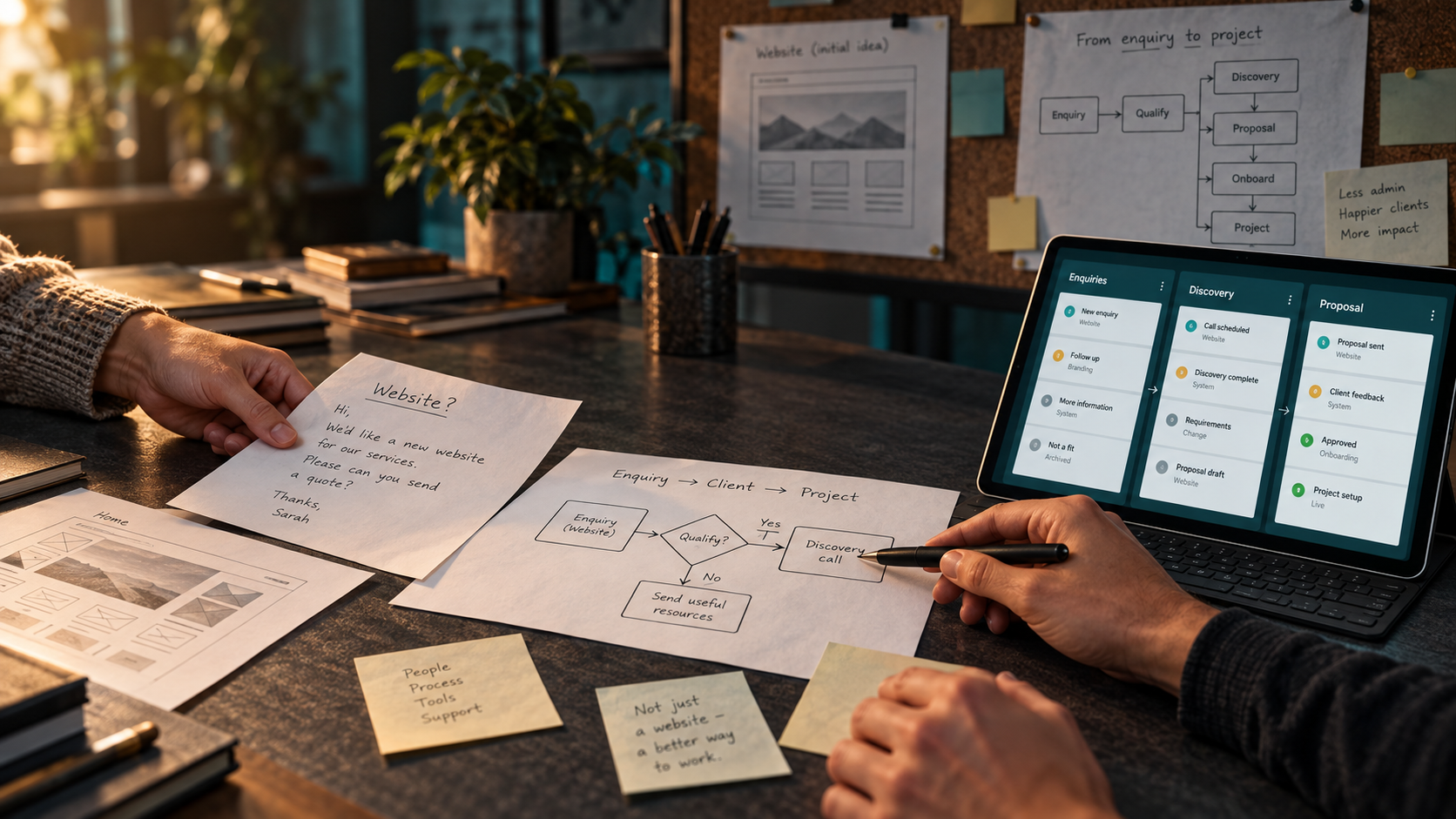
“I would like a website” sounds like a clear request. Yet it can have many different needs behind it. Some people really are missing a good website that introduces their business. Others struggle to keep track of incoming enquiries, prepare every quote manually, or have to enter the same data in several places.
I would not suggest the same solution for all of those. A new interface alone will not necessarily fix the fact that nobody replies to an enquiry in time, or that preparing a quote first means cross-checking three spreadsheets. That is why I want to start more conversations with the daily work: what happens now, who does it, and which part is difficult?
From there, it becomes easier to decide whether a better website, an integration, a simple automation or a genuinely AI-assisted solution would help. The direction of development then follows from what we want to put right, rather than which tool happens to be fashionable.
What changes when we use AI as well?
One possibility I find interesting is being able to examine an idea earlier. We can produce an interface to try out, an initial working version or a draft document that gives us something concrete to discuss. A client can more easily tell us what is missing when they have more than a long list of features in front of them.
That does not make the first version a finished product. But it can show us sooner whether we have understood the task correctly. If we have headed in the wrong direction, it is better to find out during an early trial than weeks later, when several systems are already connected to the solution.
I want to put the attention this frees up towards the important decisions: what is needed in the first release, where the risks are, and which parts have to work particularly reliably. Faster implementation alone does little good if it only results in more unnecessary features.
A smaller first step can still be substantial work
Suppose a business receives all its requests for quotes by email. Someone has to pull out the relevant information, clarify what is missing and put together an initial quote. It is easy to imagine a complete enterprise resource planning system around this, even though the first useful step could be much smaller.
At first, it might be enough to make incoming requests visible in one place, give each a consistent summary, and make it clear who is responsible for the next task. Once that works well, document preparation, approval and sending can follow. This lets the business judge what is worth expanding as it uses the system.
This is an illustrative example, not a description of a particular client's results. It matters to me because it shows the kind of work I find valuable: systems built close to everyday operations, in steps that people can follow. These are also easier to develop responsibly later on.
I want to keep the direct collaboration
I lead Trevion as its founder and personally oversee product direction and technology decisions. Specialists can join according to a project's needs. Throughout that process, the client needs to know who is responsible for the work and who they can discuss the important questions with.
AI does not change that. It can help us understand the requirements, implement the solution and prepare the checks, but we cannot point to a tool when it comes to responsibility for a decision. If something does not work as agreed, it is up to us to understand why and put it right.
That is exactly what I value in long-standing client relationships: we have a shared history, understand how the other person thinks, and can speak honestly about what is not a good idea right now. I do not want to lose that because we can automate more things. What I hope for from the new tools is less time spent on mechanical tasks and more time for meaningful discussion.
Making room for ideas of my own
When you work on client projects, it is easy to put your own plans on the back burner. There is always a nearer deadline or a fix that seems more important. For me, this period is also about considering which of the solutions I have been planning for a long time deserves to take a tangible form at last.
An idea does not become good just because we can now build an interface for it faster. We still need to ask who it helps, why they would use it, and how it could be kept running over the longer term. AI can give us more room to test individual assumptions with less initial work.
That is where I see the opportunity to move forward. I want to build on the experience of the past years to create solutions for which I previously had less time or capacity. Not everything at once, and not at any cost: choose the important ones, try them, and then continue based on what we learn.
I want the work to show it
It is easy to say a lot about AI. It becomes much more interesting when clients can see, in their own processes, an enquiry becoming a structured brief, a document becoming easier to prepare, or less manual coordination being needed. This is how I want to show the way I think about development today.
Part of that is talking about the work clearly. That is also why I am writing this series: to show existing clients what I do now, and to give people who have not worked with me yet an idea of what working together could be like.
In the next part, I will take a closer look at the working process itself. I will write about where AI can help with a development task, what is worth checking in its answers, and which decisions still need a person to take responsibility for them.

Thomas Peter Kemendi
I have worked with websites and digital systems for almost twenty years. These articles explore the perspective I have developed along the way, the reasoning behind engineering decisions and what technological change has taught me.
About meComing next · Part 4
How I work with AI — and what I still will not leave to it
In the next part, I look at my development process: where AI helps, how I check the results, and which decisions remain my responsibility.
Read the articleAll articles